
Help Protect Millions of Migrating Birds
Give Them Safe Passage Through Louisiana by Turning Out Lights in the Spring and Fall
Each fall, an estimated 500 million birds pass through Louisiana on their journey south. Many will make that journey under the cover of darkness, traveling hundreds or even thousands of miles between their nesting and wintering grounds.
You may never see them. But they’ll be flying over our homes, communities, forests, wetlands and coastlines as they make their way through Louisiana. Fall migration also brings millions of young birds making their first long-distance journey south. For them, the nighttime skies are unfamiliar territory.
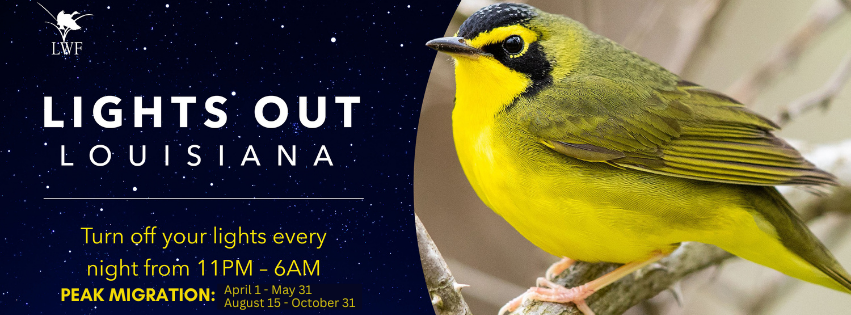
Louisiana sits within the Mississippi Flyway, one of North America's major migration routes, with the largest concentration of birds in the southwest parishes. Our forests, wetlands and coastline provide important places for birds to rest and refuel along the way.
One of the most fascinating things about bird migration is that you can actually watch it happening—even when you can't see the birds.
BirdCast, a migration dashboard from the Cornell Lab of Ornithology, uses weather radar and other information to show when and where large numbers of birds are expected to migrate, offering a Louisiana dashboard as well as dashboards for several Louisiana communities.
Dashboards for Louisiana and selected cities:
- Louisiana – https://dashboard.birdcast.info/region/US-LA
- Alexandria – https://dashboard.birdcast.info/region/US-LA-079
- Baton Rouge – https://dashboard.birdcast.info/region/US-LA-033
- Houma – https://dashboard.birdcast.info/region/US-LA-109
- Lake Charles – https://dashboard.birdcast.info/region/US-LA-019
- Lafayette – https://dashboard.birdcast.info/region/US-LA-055
- Monroe – https://dashboard.birdcast.info/region/US-LA-073
- New Orleans – https://dashboard.birdcast.info/region/US-LA-071
- Shreveport – https://dashboard.birdcast.info/region/US-LA-017
A journey that happens mostly at night
Most migratory birds make their journeys at night. They typically begin flying about 30 to 45 minutes after sunset, with migration often reaching its greatest intensity later in the evening. They typically fly at 1,000 or 2,000 feet or more, but will descend to the ground for rest or because of weather.
Dark skies give birds important advantages. They can avoid some predators, take advantage of calmer air and use celestial cues, including the moon and stars, to help navigate.
But artificial light can interfere with that journey.
Bright lights and the skyglow created by cities can attract and disorient migrating birds, drawing them toward buildings and windows. The results can be deadly. In one widely reported example, as many as 1,000 birds were killed in collisions with a single Chicago building in one night during fall migration. It
That's why the simple act of turning off unnecessary lights can make a difference.
What Is Lights Out Louisiana?
The Lights Out Louisiana initiative is part of a growing effort to reduce the dangers artificial light creates for migrating birds. The idea is simple: Turn off unnecessary lights during the hours when migrating birds are most likely to be flying.
The first Lights Out program began in Chicago in 1999. Today, Lights Out efforts have spread to communities across the country, including Louisiana.
You don't have to turn your home or business completely dark. The goal is to reduce unnecessary light while maintaining essential safety and security lighting.
At Home and in Your Neighborhood
Individuals and neighborhoods can help migrating birds by:
- Turning off non-essential lights from 11 p.m. to 6 a.m. during migration.
- Avoiding landscape lighting directed at trees or gardens where birds may be resting.
- Aiming essential security and safety lights downward.
- Using light shields to direct light downward and reduce upward glare.
- Using motion detectors or sensors so lights come on only when needed.
- Closing blinds at night to reduce the amount of light visible through windows.
These are small changes, but multiplied across neighborhoods and communities, they can significantly reduce the amount of unnecessary light birds encounter during migration.
For Businesses
Businesses can take many of the same steps:
- Turn off non-essential lights from 11 p.m. to 6 a.m. during migration.
- Avoid landscape lighting on trees and gardens where birds may be resting.
- Complete custodial work by 11 p.m. and turn off lights after cleaning.
- Aim essential security and safety lighting downward.
- Use shields to prevent upward glare.
- Install motion detectors and sensors where appropriate.
- Close blinds at night to reduce interior light escaping through windows.
For businesses that operate large buildings, reducing light can be particularly important because large, illuminated structures can create significant collision hazards.
Special Considerations for Tall Buildings
Buildings higher than three stories and structures with large areas of glass can present additional risks for migrating birds.
Building owners and managers can consider:
- Installing bird-safe window films designed to reduce collisions.
- Dimming or turning off exterior and decorative lighting.
- Turning off lobby and atrium lighting when it isn't needed.
- Turning off perimeter room lights, particularly on upper floors.
- Turning off floodlights.
- Eliminating unnecessary lighting around interior plants and fountains.
- Turning off lights on vacant floors.
- Reducing the use of blue-rich white light, particularly lighting above 3000K.
Where light is necessary, consider warm-white or filtered LED lighting below 3000K and use desk or task lamps instead of overhead lighting when practical.
Meet Some of Louisiana's Bird Travelers
The birds passing through Louisiana this fall come in all shapes, sizes and colors. Below are some of the travelers, with descriptions drawn from Cornell Lab’s All About Birds guide.
Painted Bunting
Few birds are as colorful as the Painted Bunting. Males are especially striking, with blue, green and red plumage that makes them one of Louisiana's most recognizable songbirds.
Painted Buntings are long-distance travelers. Each fall, many head south from their nesting grounds toward wintering areas mostly in the Caribbean and parts of Central and South America, passing through Louisiana along the way.
For a bird this small, it's an extraordinary journey—and much of it happens after dark.
Scarlet Tanager
The Scarlet Tanager looks almost tropical, with its brilliant red body and contrasting dark wings. But this striking songbird is another nighttime traveler passing through Louisiana during migration.
After nesting farther north, Scarlet Tanagers head south for the winter. Along the way, Louisiana provides important habitat where they can stop, rest and refuel.
Their journey is a reminder that the birds we see in Louisiana may be connected to ecosystems hundreds or thousands of miles away.
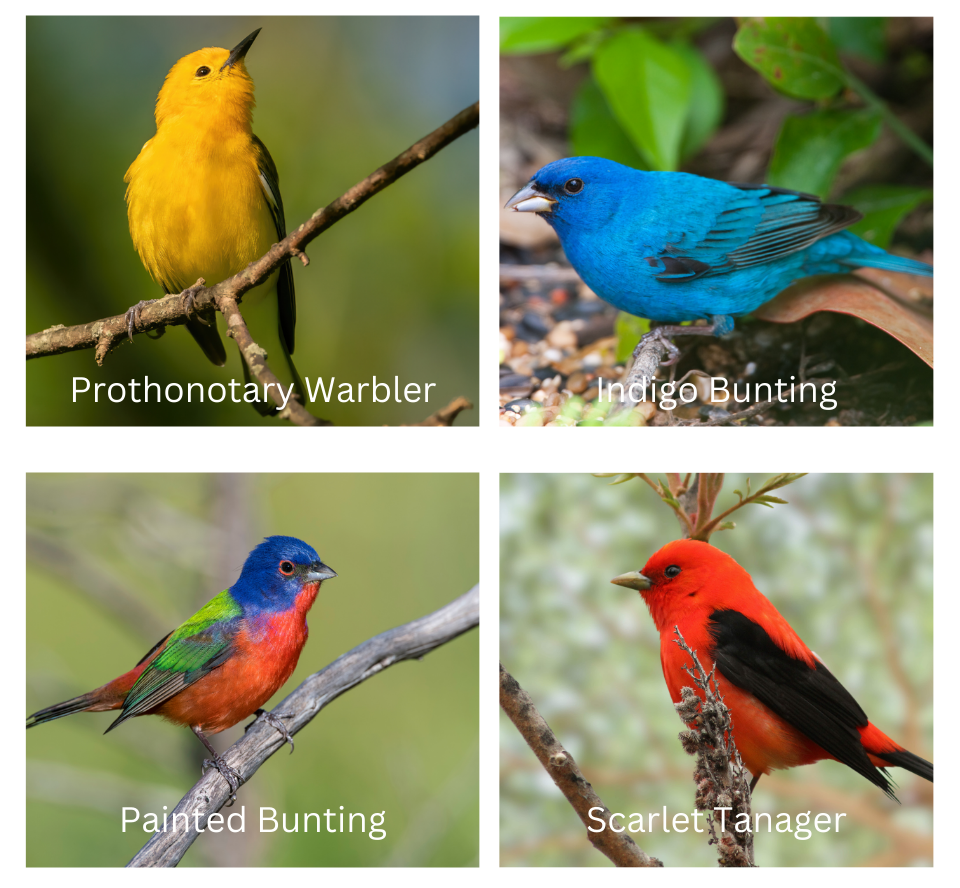
Prothonotary Warbler
The bright yellow Prothonotary Warbler has a particularly strong connection to Louisiana. It is closely associated with the state's forests and wetlands, including the bottomland forests and swampy habitats that make Louisiana such an important place for birds.
Some Prothonotary Warblers nest here, while others pass through during migration.
Protecting Louisiana's wetlands and forests therefore does more than preserve places we enjoy—it helps provide habitat for birds throughout their annual journeys.
Give them a safe passage
For the birds making their way south this fall, Louisiana is more than a place on a map. It is part of a journey that connects nesting grounds, wintering grounds and habitats across an entire continent.
We can't control every hazard these birds encounter along the way. But we can control the lights we leave on at night.