

Louisiana plays an extraordinary role in migratory birds’ annual journeys. Positioned along the Mississippi Flyway and serving as a critical passageway and stopping point for birds traveling between North and South America, the state sees hundreds of millions of birds pass through its skies each spring and fall.
But the journey is filled with challenges. Artificial lighting, glass-covered buildings, and habitat loss can disrupt migration and threaten bird populations already facing significant pressures.
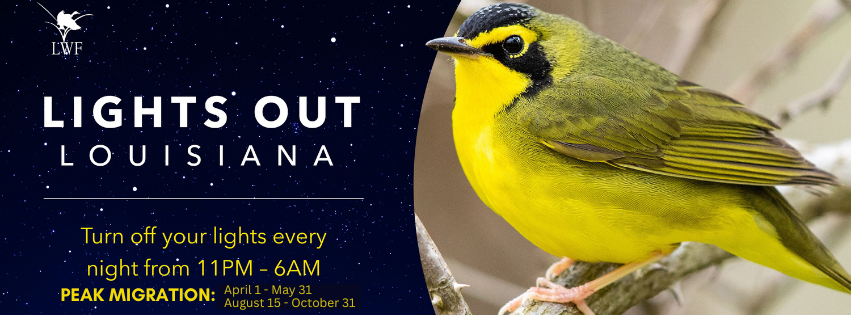
The Louisiana Wildlife Federation’s Lights Out Louisiana effort offers simple ways to help protect migrating birds.
Erik Johnson, a bird conservation scientist and assistant professor at LSU’s School of Renewable Natural Resources, spent more than 14 years with the National Audubon Society, where he held leadership positions in bird conservation and applied conservation science.
In this Q&A, he discusses what makes Louisiana so important to migrating birds, the challenges they encounter along the way, and how simple actions can help make their journeys safer. He also shares insights from his research and explains why protecting birds during migration is an important part of conserving Louisiana’s natural heritage.
For people who may not realize it, what makes Louisiana such an important place for birds during migration?
Almost 500 species of birds have been documented in Louisiana, making it one of the birdiest states in the country.
We also sit at a key location along the Mississippi Flyway, being the first or last land hundreds of millions of migratory birds see each spring and fall, respectively, as they make the 600-mile non-stop journey across the Gulf. Some of these birds, like Bobolinks, White-rumped Sandpipers, and Hudsonian Godwits, travel between the Arctic and southern South America.
What is happening in the skies over Louisiana during fall migration, and what are the biggest challenges birds face as they make that journey?
Most migratory birds migrate at night, and lighting from cities, industries, highways, and other human infrastructure can disorient birds during these journeys, causing them to get exhausted from getting trapped in these “light bubbles,” or even worse, colliding into buildings.
Glass especially is a problem because it either appears transparent or reflective, making birds think they can pass through it. About 1 billion birds collide into buildings each year in the U.S., and this is an important part of the explanation for why we have lost about 28% of our migratory bird populations over the last 50 years.
Lights Out Louisiana asks people and businesses to turn off unnecessary lights during migration. What difference can a relatively simple action like that make?
Being strategic about minimizing your use of lights at night is important to help birds navigate along their migratory routes more efficiently and effectively, to make sure they guide themselves into appropriate habitat, rather than into our busy and disruptive urban landscapes. Not wasting photons of light that have no real purpose will also save you money! Motion-sensing lights are a great alternative if safety risks are necessary to address, where they stay off most of the time except when needed.
You’ve spent much of your career studying birds and migration, including species that pass through Louisiana. What have you learned that has changed the way you think about these migrations?
One of the more remarkable things I have learned is that some birds actually migrate in one single “jump” farther than the Gulf is wide.
For example, Swainson’s Thrushes, a bird that weighs about 30 grams (<1/10 of a pound) have been documented flying directly from Colombia to the U.S., a distance of over 1800 miles. We have recently documented a Protonotary Warbler, weighing <15 grams, flying non-stop between Nicaragua and Louisiana, a flight of about 1200 miles.
The energetic demands of these kinds of journeys are unparalleled. This also makes them so extremely vulnerable to disruptions, like habitat loss and light pollution.
You’ve also had a long association with the Louisiana Wildlife Federation. How did that relationship begin, and what does LWF’s role in bird conservation mean to you?
Wow, yeah, I’ve worked alongside LWF in some capacity or another soon after I started working with the National Audubon Society as a conservation biologist in 2011.
From the amazing leadership by Executive Director Rebecca Trish to the dedicated staff, board, and volunteers, LWF is an incredibly effective and respected leader in promoting access and opportunities for outdoor recreation, habitat protection, and ecosystem restoration in our great state of Louisiana. I am excited to engage students in their work now that I have joined the faculty at LSU.
If you could leave Louisianans with one thing to understand—or one thing to do—as millions of birds move through the state this fall, what would it be?
You often can’t see migration in action, but if you look at the signs, you will see it happening. Some birds will disappear and others will appear, while thousands more may have flown over your house while you were sleeping.
Take a moment to look at your surroundings – identify the positive things, like native plants, or negative things, like windows, that may affect birds on these journeys. Think about what you can do to make this passage of the seasons more helpful to our feathered friends.