
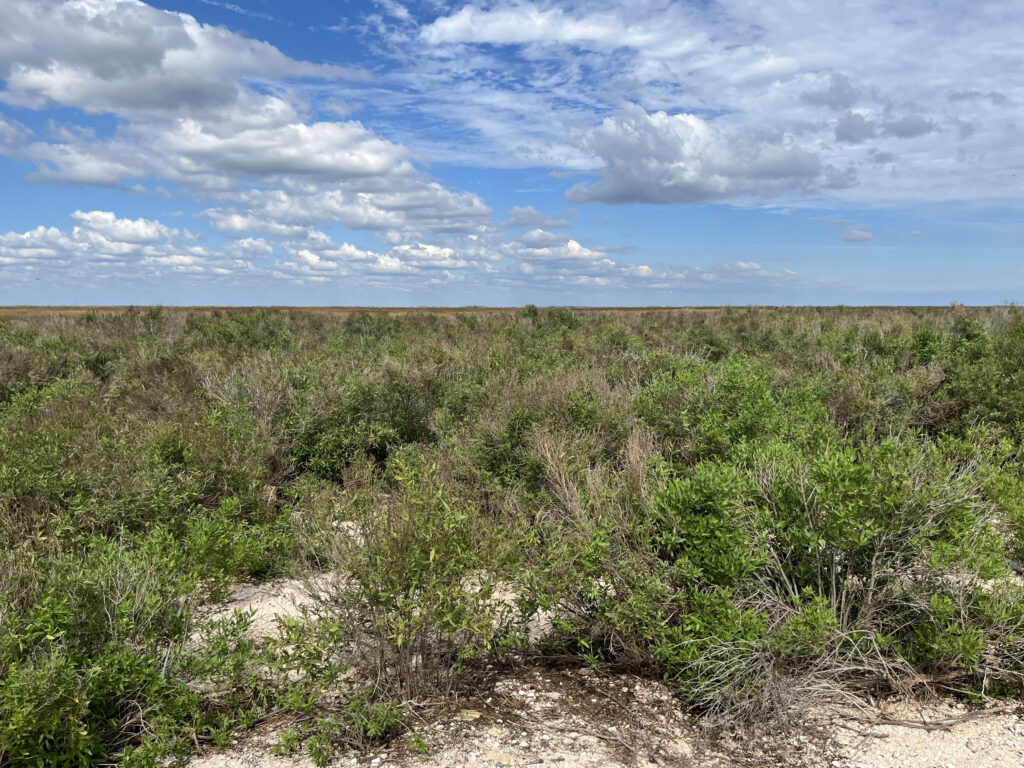
The U.S. Department of Transportation and the Federal Aviation Administration (FAA) are accepting comments on a Request for Information (RFI) on the siting of new commercial spaceports and the development of priority airspace for critical space launch corridors. The Louisiana Wildlife Federation has submitted comments and urges interested parties to add their voices.
***
ACT NOW
The FAA is accepting comments on an RFI for “Siting New Spaceports and Use of Priority Airspace for Critical Space Launch Corridors” 91 FR 54909 (Aug. 25, 2026); Docket No. FAA-2026-9736.
- Go here to send in your comments by October 26: https://www.regulations.gov/docket/FAA-2026-9736
- Read LWF’s comments here: https://lawildlifefed.org/wp-content/uploads/LWF-FAA-Siting-Comment-2026-9736-Final-10-19-2026.pdf
***
LWF’s Stance
On Aug. 25, SpaceX and Gov. Jeff Landry announced plans to build Starbase Louisiana, a massive commercial spaceport in coastal Vermilion Parish. LWF is not opposed to space development. We do have recommendations for criteria in selecting appropriate sites. Before a location is selected and substantial public and private investment is committed, LWF urges the U.S. Department of Transportation and FAA to adopt criteria to identify and weigh:
- environmental durability
- wildlife and habitat conflicts
- existing aviation and maritime uses
- public access
- coastal hazards
If the proposed Vermilion Parish facility is intended to support thousands of launches a year and multiple launches a day, there should be more consideration for whether the surrounding airspace, waters, infrastructure, communities, and natural resources can absorb repeated launch operations over decades.
LWF answered several questions posed by the FAA in its Request for Information.
QUESTION 1 — A Viable Spaceport Has to Be Durable, Not Just Well-Positioned for Launch
Siting should account for the conditions that create predictable long-term cost, operational constraint, public-access conflict, or environmental harm, including:
- Coastal land loss and shoreline stability
- Hurricane and storm-surge exposure
- Adjacent public land and natural resources shared by the public
- Existing aviation activity
- Existing offshore energy infrastructure
- Low-probability, high-consequence hydrologic risk
- Competing demand for dredging capacity and sediment
QUESTION 4 — Environmental Review and Public Engagement Are Worth Most Before a Site Is Chosen
- Stakeholder engagement, environmental issues, and airspace integration should be addressed early while location selection is still a variable and before choices have narrowed
- Early evaluation of environmental and operational conflicts affecting wildlife habitat, aviation, fisheries, navigation, and public access can support infrastructure and site design decisions
QUESTION 5 — Launch Corridors Have Consequences in the Air and on the Water
A launch corridor does not exist only in FAA-controlled airspace. Its safety footprint reaches aircraft, vessels, fishermen, hunters, offshore workers, energy infrastructure, and wildlife beneath the trajectory. Some considerations include:
- Aviation conflicts
- Maritime safety zones and public waters
- Wildlife and habitat along the corridor
QUESTION 6 — The RFI Asks Where Spaceports Can Go, But Not Where They Should Not
What combination of environmental, operational, access, and infrastructure conflicts should make a location presumptively unsuitable for a major new spaceport?
A location can satisfy launch-trajectory criteria and still be a poor national infrastructure choice once those cumulative conflicts are weighed.
Using coastal Louisiana as an example, a complete framework could include:
- severe and continuing coastal land loss
- extreme hurricane and storm-surge exposure
- extensive wetlands whose fragmentation would be hard to reverse
- immediate proximity to national wildlife refuges or state conservation lands
- listed-species habitat
- nationally significant migratory-bird concentrations
- conflicts with heavily used aviation corridors
- launch trajectories crossing concentrations of offshore energy infrastructure
- repeated restriction of productive fishing areas
- significant loss of public hunting, fishing, and boating access
- a cadence requiring frequent maritime or aviation closures
- competition with public restoration, protection, and navigation projects for dredging capacity and suitable sediment
- major long-term hydrologic or geologic risk
LWF’s Recommendations
- Build environmental and operational durability into national siting criteria, including coastal land loss, subsidence, storm surge, long-term hydrologic change, competing demands on dredging capacity and sediment, and other conditions affecting a facility’s useful life.
- Map proposed launch corridors against existing aviation activity, including Gulf oil-and-gas helicopter routes, offshore heliports, agriculture aircraft, emergency aviation, and other established traffic.
- Map corridors against offshore infrastructure, including oil and gas platforms, LNG facilities, pipelines, vessel routes, and related safety and security zones.
- Evaluate reasonably foreseeable Coast Guard restrictions at the siting stage, including maritime safety zones and the possibility that high cadence could require increasingly frequent, if not permanent, navigation controls.
- Quantify impacts on public access, including commercial and recreational fishing, charter operations, hunting, boating, and navigation.
- Evaluate cumulative operational effects using the anticipated launch cadence, rather than treating each launch as an isolated event.
- Establish an early environmental-sensitivity screen identifying combinations of wetlands, public conservation lands, listed-species habitat, and other resources that weigh strongly against site selection.
- Require meaningful state and local participation before preferred sites are chosen, including fish and wildlife agencies, coastal-management agencies, the Coast Guard, aviation interests, fisheries interests, and affected communities.
- Consider low-probability, high-consequence regional hazards, including major hydrologic changes capable of affecting the long-term viability of permanent infrastructure.
- Develop explicit criteria for unsuitable locations, recognizing that effective national siting policy must identify not only where a spaceport can be built, but where its long-term conflicts make another location preferable.
LWF supports continued American leadership in the commercial space industry and recognizes the need for additional launch capacity. But the scale contemplated by this Request for Information, and by the Louisiana project now being developed, calls for a siting framework built for the next generation of spaceflight, not the launch cadence of the past. At thousands of launches a year, siting becomes more than a matter of available land and open-water trajectory. It becomes a question of whether repeated launch operations can coexist with the aviation, maritime, economic, public-access, and natural-resource systems already occupying that landscape.