
As the 2026 legislative session enters its final month, Louisiana is approaching a critical point in how Chronic Wasting Disease (CWD) will be managed moving forward. Several legislative efforts are now advancing that reflect very different approaches to addressing this complex issue.
A Shift in the Conversation
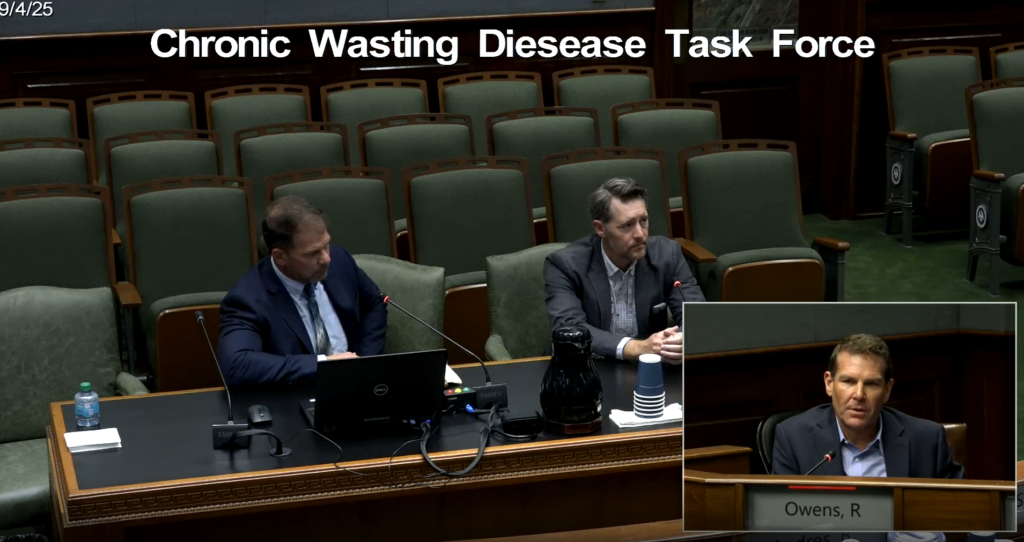
The Legislative CWD Task Force was created to evaluate Louisiana’s current management strategy and provide recommendations for the future. Louisiana Wildlife Federation (LWF) has maintained an active role throughout this process as a participating member of the Task Force, engaging directly in discussions and submitting formal recommendations for consideration. Listen to the April 2026 Meeting.
Over the course of the Task Force meetings, the conversation has increasingly centered on deferring disease management with economic impact concerns, particularly those affecting agricultural interests and feed sales. While these concerns are part of the broader discussion, CWD remains a fatal, transmissible disease with no treatment. Management decisions should continue to reflect that reality and be grounded in the best available science and Louisiana-specific conditions.
SCR 24 – A Reduced but Structured Framework
Senate Concurrent Resolution 24 (SCR 24) has emerged as the primary legislative vehicle coming out of the Task Force process, authored by Task Force leaders Senator Womack and Representative Riser and co-authored by Senator Cathy, who together represent the majority of areas currently impacted by CWD in Louisiana.
SCR 24 proposes significant changes to Louisiana’s current management framework, including:
- Reducing containment zones from a 25-mile area with a 15-mile inner no-feeding zone to a 15-mile zone with a 5-mile inner restriction
- Establishing a 1.5% prevalence threshold, based on testing data, before feeding and baiting restrictions are triggered
If enacted, SCR 24 would replace existing LDWF regulations and substantially reduce the geographic footprint of current restrictions. Based on current data, this would likely leave only a limited area in Tensas Parish, near the Winter Quarters region, under feeding restrictions heading into the next hunting season.
SCR 24 has already passed the Senate without opposition and is now moving through the House process.
From LWF’s perspective, while SCR 24 falls short of our recommendations for a stronger, science-based management approach, it does retain a structured framework tied to disease prevalence, surveillance, and geographic conditions. At a minimum, it maintains a science-based foundation for continued management.
HCR 4 – Removal of Management
House Concurrent Resolution 4 (HCR 4), authored by Representative McCormick, takes a fundamentally different approach.
HCR 4 proposes to remove feeding and baiting restrictions within CWD zones. The measure has advanced through the House and is expected to be considered by the Senate in the coming weeks.
LWF strongly opposes HCR 4.
This resolution acknowledges that CWD is a fatal cervid disease that persists in the environment, yet proposes to remove one of the primary tools used to manage its spread, without replacing it with a structured, science-based framework.
In effect, HCR 4 does not represent a management strategy. It removes management.
It is not tied to disease prevalence.
It is not tied to surveillance data.
It does not provide a path forward if conditions change.
Additionally, the concerns cited in HCR 4 are already addressed within existing rules and SCR 24. At its core, the resolution is driven by economic concerns related to corn and deer feed sales. While those impacts are acknowledged, they are not a sufficient basis to remove management of a fatal wildlife disease.
Two Different Paths Forward
With both SCR 24 and HCR 4 advancing, Louisiana is now considering two very different approaches:
- SCR 24 – A reduced but structured framework that maintains a science-based management approach
- HCR 4 – The removal of management tools without a defined framework
The distinction is important.
While LWF believes Louisiana should pursue a stronger, science-based management strategy than what is proposed in SCR 24, maintaining a framework tied to data, surveillance, and conditions on the ground is essential.
Removing that framework entirely is not.
What This Means for Hunters
CWD management is already a complex and evolving issue for Louisiana hunters. As regulations change, clarity and consistency are critical.
Advancing conflicting approaches only increases confusion and makes it more difficult for hunters to understand and comply with the rules. A clear, structured path forward, grounded in science and adapted to Louisiana conditions, is essential to maintaining both participation and confidence in the system.
Looking Ahead
HCR 4 is expected to be heard in the Senate Natural Resources Committee in the coming weeks. LWF will continue to actively engage in that process and advocate for a science-based approach to CWD management.
At the same time, discussions will continue around the broader framework for managing this disease in Louisiana, including areas that have not yet been fully addressed. LWF will remain actively involved in those conversations and continue to advance our recommendations as part of that process.
CWD is not a short-term issue. The decisions made during this session will have long-term impacts on Louisiana’s deer herd and hunting traditions.
LWF remains committed to ensuring that those decisions are grounded in sound science, reflect Louisiana-specific conditions, and support the long-term health of the resource.
Read our statement on CWD in Louisiana: Recommendations for Responsible Management.